


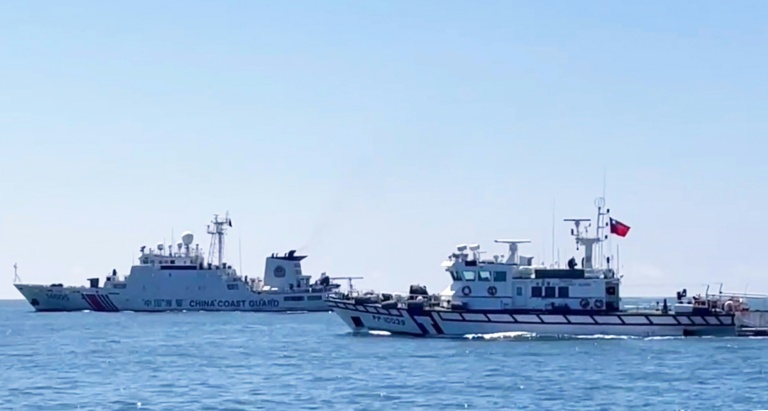
Escalating Maritime Presence Around Taiwan
China has significantly increased its maritime presence around Taiwan, deploying a record number of coast guard, scientific research, and other vessels in the region. This surge in activity has raised concerns among Taiwanese officials and analysts, who see it as part of Beijing’s broader strategy to assert control over the waters surrounding the island.
According to data shared with Wartabrita.com, the number of Chinese ships detected near Taiwan’s main island reached a record 244 in July, averaging nearly eight per day. This is a sharp increase from 55 in June and 30 in May, with only 58 recorded in July of the previous year. In the first 21 days of this month alone, 152 vessels were detected, highlighting a growing trend.
Approximately 60% of these vessels are coast guard ships, while the remaining 40% consist of research vessels and other government boats. It is important to note that these figures do not include Chinese warships, which are regularly deployed around Taiwan on a near-daily basis.
China has long used such vessels to assert authority over contested waters, particularly in the South China Sea, where Beijing claims territorial rights over several islands and reefs. Analysts describe these actions as “grey zone” tactics—measures that fall short of an act of war but still serve to challenge the status quo.
The total number of Chinese vessels detected around Taiwan and its outer islands since May has reached 1,247, according to coast guard figures. A senior official from the Taiwanese coast guard, speaking on condition of anonymity, emphasized that the situation is becoming increasingly severe due to the rising number of government vessels in the area.
The official noted that China has never ruled Taiwan, stating, “Without sovereignty over land, it has no right to claim economic zones at sea.” This sentiment reflects the broader tension between the two sides, as Beijing continues to assert its claim over Taiwan, despite the island’s de facto independence.
Submarine Warfare Concerns
One of the primary concerns associated with the increased presence of Chinese vessels is their potential role in submarine warfare. The Taiwanese coast guard has pointed to activities by Chinese research ships, such as the “Tong Ji,” which circled Taiwan in May, tracking the edge of the island’s restricted waters and refusing to comply with orders to leave.
These operations are believed to involve oceanographic sampling and seabed surveys, which could contribute to China’s anti-submarine warfare databases. The coast guard has warned that such activities may be aimed at gathering critical data that could be used in future conflicts.
In June, China conducted its first law enforcement patrol in waters east of Taiwan, further escalating tensions. More recently, China announced “traffic control measures” for the Taiwan Strait as Typhoon Dolphin approached the region, adding to the sense of uncertainty.
Clear Escalation in Maritime Strategy
Experts have observed a significant increase in the number of Chinese research vessels operating around Taiwan, especially to the east of the island. Ryan D. Martinson, an expert on China’s maritime strategy at the US Naval War College, notes that while this is not a new tactic, the scale of operations around Taiwan is unprecedented.
“These developments represent a clear escalation in Beijing’s efforts to exercise jurisdiction over the waters surrounding Taiwan,” Martinson said. He added that the data collected by these vessels is highly valuable for the Chinese military, particularly for anti-submarine warfare and submarine operations.
Jason Wang, chief operating officer of ingeniSPACE, highlighted that China’s “Xiang Yang Hong 03” research vessel was recently observed operating within Taiwan and Japan’s exclusive economic zones. The vessel moved over deep sea trenches and telecoms cables, raising concerns about its intent.
Wang also noted that this was the first time a Chinese maritime militia boat escorted a research vessel in Taiwan’s waters, indicating a shift in strategy. According to Wang, China’s objective appears to be gathering hydrographic data to support anti-submarine warfare efforts and to prevent other nations from doing the same.
Conclusion
The growing presence of Chinese vessels around Taiwan signals a significant escalation in Beijing’s maritime strategy. As tensions continue to rise, the implications for regional stability and security remain a pressing concern. With both sides engaged in a complex web of political, military, and strategic maneuvers, the situation remains fluid and unpredictable.

Tinggalkan Balasan